The Moonspeaker:
Where Some Ideas Are Stranger Than Others...
GENDERED TIME IN THE ARCHAEOLOGICAL RECORD
ABSTRACT
Conceptions of time are fundamental to archaeological understanding, making it possible to reconstruct past events. As with any reconstruction, its plausibility depends on the data acquired, and this has been the predominant focus of processual archaeology. The development of the post-processual critique showed that not only the data itself, but the theories and motivations of archaeologists and of peoples in the past could affect the accuracy of interpretation and reconstruction in the present. This has been extended to issues of gender only recently by the Feminist critique of archaeology, which began showing the various ways gender bias had impacted archaeological theory and practice.
INTRODUCTION
Archaeology is usually defined as the study of past human societies, or more liberally as the study of past human behaviour (Thomas, D. H. 1998; Rathje and Murphy 2001). It is also one approach to the challenge of measuring time that has already passed for particular societies. Until the 1990s, how archaeologists should approach this challenge seemed simple enough, based on two approaches:
- 'from the outside,' using selected artifacts to produce a relative timescale for a given archaeological culture
- 'from the inside,' trying to understand the concepts of time used by a given archaeological culture using some combination of information from calendars, monuments, and ethnographic analogy (Gilchrist 1999)
By the early 1990s, the post-processual and Feminist critiques of archaeology had begun to reexamine these approaches. Archaeologists and anthropologists began to argue that concepts of time were far from neutral, and that the rate of change implied by artifacts could vary with the social identity of the creators and users of the artifacts (Gosden 1994; Thomas, J. 1996, Fabian 1983). Other archaeologists working from the late 1990s to the present have shown that gender bias specifically can affect both of these approaches to archaeological time, through artifact selection and our own gendered notions of time (e.g. Picazo 1997; Doucette 2001; Stalsberg 2001).
Concepts of time used by archaeologists, like the artifacts they recognize and interpret, tend to be entrained with the binary gender concepts developed recently in the West, a corollary of the fact that most archaeologists to date have been Westerners or trained in Western traditions. Despite even more recent questioning and deconstruction of the binary gender model, many archaeologists still see this model as ‘natural’ or even ‘inevitable.’ This can lead to serious, preventable distortions of the archaeological record, as well as prevent us from noticing important information. In order to show how such distortions can develop, I will briefly examine five major Western conceptualizations of time and their gender associations, and how they intersect with the two approaches to understanding past time.
CONCEPTS OF TIME
Artifacts from as early as the Upper Palaeolithic period (approximately 200 000 - 10 000 years BP) are suggestive of a human desire to track time (Marshack 1972), but important shifts in approaches to how it is viewed and understood begin with the effort to define and later manage it. Some of the earliest and best known writings about time are those composed by the Pythagorean and Platonic philosophers of Ancient Greece, whose first stumbling block was language. It is no easy feat to talk about time as independent of human experience before it has been named with an abstract noun. Another stumbling block (already implied in the previous sentence) is the recursive nature of the human experience of time, which is demonstrated by the definition given below.
- experiential time: paraphrasing Christopher Gosden, experiential time is the human experience of the present through remembering the past and anticipating the future by using memories of the past (Gosden 1994).
An impressive number of other conceptions of time have been abstracted from this basic one, but only five will be covered here. These five are inclusive of most approaches to speaking about and understanding time used by archaeologists to date, and the definitions demonstrate almost immediately that those archaeologists have been primarily westerners or trained in western intellectual approaches.
- absolute time: is unidirectional, irreversible, and has nothing to do with human agency (Halliday et al 2001, Thomas, J. 1996); this concept is the same as Stahl's 'physical time' in that it is 'non-cultural and anchors human development' (Stahl 1993: 237).
- linear time: is also unidirectional and irreversible, and is strongly associated with the masculinity (Trigger 1999, Northrup 2001); this includes Stahl's mundane time (time broadly divided into phases and stages) and typological time (naming of blocks of time in ways that imply qualities about them) (Stahl 1993: 237).
- cyclical time: which involves the repetition of a limited sequence of events (i.e. menstruation, religious devotions), and is strongly associated with the femininity (Gimbutas 1989; Thomas, J. 1996; Freeman 1999, Northrup 2001).
- public time: a form of linear time managed and measured by a central authority (Gosden 1994).
- private time: time that is not directly structured by a central authority (Picazo 1997; Gosden 1994).
The gender associations of linear and cyclical time depend upon three presuppositions:
- There are two biological sexes, female and male.
- Sex and gender are equivalent.
- Biology determines how an individual experiences time and acts over time.
Added to these presuppositions is a wide-ranging series of binaries defining 'masculine' versus 'feminine' qualities, interests, spheres of activity, and abilities. Public time and private time are also (indirectly) gendered in this system, via the association of femininity with the 'private' or 'domestic' sphere and masculinity with the 'public' sphere (Baker 1997; Picazo 1997). These are all distinctively 'western' preconceptions, and are not necessarily shared by other cultures.
Clearly 'masculine' linear time more closely resembles absolute time than 'feminine' cyclical time, and its inherent directionality marks it as a source of change and/or progress, which are themselves conceptualized as linear phenomena. The 'feminine' is set into the category of 'the natural' with its 'static timelessness' (Baker 1997). A frequently cited example of how these associations affect interpretations of archaeological evidence is the original formulation of human evolution as something that males did and females passively benefited from (Hrdy 1999; Zihlman 1998). The effects on the archaeology of modern humans are just as pervasive, but not always so blatant.
The way in which these gendered concepts of time can skew relative chronology building is closely related to present day western valuations of women's work. Women tend to be associated with 'invisible' activities carried out within the home that are perceived to have lower value because a wage is not received for performing them. Or, if women are working outside of the home, their work is often defined as somehow less prestigious or less difficult (Bernholdt-Thomsen et al. 2001, Davis 1993). These activities are defined as invisible despite the fact that they produce most of the artifacts recovered and are necessary for a society to persist and subsist over time (Picazo 1997). A sharply sex-based division of labour in which women use and produce artifacts that rarely survive in the archaeological record is also often asserted in the face of contrary evidence and the results of different recovery techniques (Wood 1998; Gero 1990). Binford and other processualists tend to define these activities as epiphenomena, that is, dependent on other phenomena that occur outside of the home. Epiphenomena are inaccessible to archaeologists and in any case unnecessary for them to access, because the phenomena are accessible (Binford 1983; Wylie 1997; Trigger 1999). Post-processualists often define these female-associated activities as habitual and therefore without meaning because they do not continuously require conscious thought (Gosden 1994).
The end result is a construction in which the activities of males are de facto public and considered preferentially visible in the archaeological record. Furthermore, 'male' activities are more meaningful and interesting, and 'male' time seems to entrain with absolute time. After all, cyclical time supposedly does not lead to change, and it is change that archaeologists typically wish to study, although it may be more fruitful to ask questions about how certain types of change are resisted and why members of a society stop resisting or continue to resist different types of change.
A more indirect use of this approach is in the selection of ethnographic analogies for 'fleshing out' a given archaeological culture, an application examined by Ann Brower Stahl (Stahl 1993). Concepts of time applied to a given culture become a means of deciding which ethnographic analogies 'fit.' During the Enlightenment, travelling in space was equated with experiencing time (Stahl 1993: 237), culminating in Lewis Henry Morgan's unilineal system of human social evolution (Stahl 1993; Trigger 1999). So if all societies would ultimately pass through the same stages, it would be appropriate to compare Australian Aborigines to Palaeolithic Europeans. The same gender-time associations then also applied to all people, so it could be expected that the same binary gender system existed. At first Indigenous North Americans were considered exceptions to the unilineal evolution paradigm, with each 'tribe's' stage being determined by geography but otherwise remaining static through time (Trigger 1999). This allowed some blurring of the boundaries between what non-Indigenous anthropologists identified as 'female' and 'male' roles as actors and developers in the archaeological interpretation of Indigenous North American societies.
It might seem that the influence of modern day concepts of time should not be as influential on attempts to understand the chronological concepts of past people, but this is far from the case.
Women have been particularly associated with the Moon by western cultures, predominantly through the influence of Middle Platonic Greco-Roman writings and philosophy (Freeman 1999; Walker 1983, Johnston 1990). It is also known that in conditions where artificial light is little or not available, and no other factors interfere (e.g. severe, long term stress from lack of food or severe exercise), a woman's menstrual cycle will become synchronized with the Moon's phases. From this the following logical sequence can be made:
- Women menstruate in synch with the Moon when artificial light is minimally available or used. The average length of a menstrual cycle also happens to be almost the same as the Moon's cycle of phases.
- Artificial light was minimally available or used in Palaeolithic times.
- Women wish to control when or if they conceive and predict when their babies will be born; one way to achieve these things in the Upper Palaeolithic was to observe the Moon and their own menstrual cycles, given points (1) and (2).
- Women are forcibly reminded of the cyclical nature of their biology because they menstruate (Thomas, J. 1996).
- Men are even more forcibly reminded of their biology because their cycles of erection and loss of erection are more frequent and more visible, but that very frequency along with its irregularity militates against correlating those cycles to any astronomical phenomena.
Based on this train of thought, women seem primed to keep time in general and invent lunar calendars in particular. Yet according to scholars like Alexander Marshack (Marshack 1972, 1985), women never did either of these things. However, if we remember that in western societies calendars and timekeeping are strongly associated with public activity, control over ritual and labour, and the valuation of work based on whether an hourly wage is received, their position is easier to understand (Picazo 1997, Fabian 1983). Overt usage of power is assumed to be the prerogative of men, even a part of what defines the masculinity, while covert usage of power is placed in a similar relationship to women (Baker 1997; Woodhouse-Beyer 1999).
This leads us to an important implied compound question. Can categories of person such as gender actually affect the rates of change in a society that archaeologists infer from the artifact record? Could that inferred rate of change then indicate different rates of change in different sectors of that society depending on gender? The theoretical considerations above suggest that the answer should be some version of 'yes,' and several recent studies, while not directly confirming such an answer, indicate that it is worthwhile to pursue further work on the question.
ARGARIC BRONZE AGE SPAIN
In southeast Spain, the Bronze Age is referred to as Argaric from the type settlement site El Argar, excavated by the Siret Brothers (Moore 2003; Harding 2000). A refined relative chronology was first published for the period in 1964, based on burial type and grave good compliment. The area is considered plagued by poorly detailed stratigraphy and difficulties with radiocarbon dating (Moore 2003).
During her own work on the Argaric Bronze Age, Pamola Marcén Gonzaléz discovered that the published chronologies had been based exclusively on the grave artifacts found with skeletons sexed as male, and therefore gendered as masculine. She then developed another seriation based on the grave artifacts found with the skeletons sexed as female. The associations of artifacts found in the 'female' graves implied a slower rate of change in burial ritual than in the case of the 'male' graves (Picazo 1997). Unfortunately, it is not clear whether the graves were 'sexed' exclusively based on skeletal data, or using a combination of skeletal data and artifact compliment by either the Siret Brothers or Gonzaléz.
NEOLITHIC ÇATALHÖYÜK
James Mellaart began excavations at Çatalhöyük, an important Neolithic site on the Plain of Konya in Turkey in 1961, finishing his own work there in 1965. He has continued to write about and interpret the site ever since, and has contributed to an ongoing dialogue and controversy over the role of a Goddess or Goddesses in the religious beliefs of the site's inhabitants. Archaeological excavation resumed at the site in 1993 under the direction of Ian Hodder (Hodder 1996), spurring an overall reexamination of the materials collected by Mellaart. Of particular interest here is the 2000 work on the Mellaart era figurine collection carried out by Mary M. Voigt.
Voigt's specific purpose was to better place the figurines in their cultural and cultural historical context by developing a better understanding of how the figurines were used. In order to achieve these ends, Voigt brings together information from Levantine figurine studies at the sites of Hajji Firuz Tepe and Gritille, the figurine typology developed by Peter Ucko, and more specific information about figurine condition and placement in the case of Çatalhöyük. Although she did not produce an overt chronology, her study allows a rough sequence to be marked out using the figurines recovered so far.
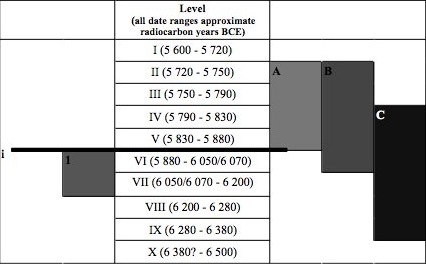
The base Çatalhöyük chronology was derived from stratigraphic levels produced by the semi-regular collapse and sometimes deliberate destruction of the mudbrick buildings in the settlement. Radiocarbon measurements were run on samples from hearths, yielding fourteen (Mellaart 1967) uncallibrated date estimations used to create the chronology presented in Figure 1, along with Voigt's interpretations of the changes in usage of figurines in Çatalhöyük (Voigt 2000). The radiocarbon dates were determined using the a C-14 half-life value of 5 568 years.
Figure 1. Changes in stone figurine usage as interpreted by Voigt, left hand column. 1967 Çatalhöyük chronology, central column. Changes in clay figurine usage and type as interpreted by Voigt, right hand column. Figurine evidence for levels I and X is either non-existent or too confused for interpretative purposes.
i = possible change in religious beliefs between these levels, marked by alteration in stone figurine treatment and appearance of 'fat lady' clay figurines
1 = 31 out of 35 stone figurines were recovered from these levels, with the majority of these found in two buildings in the lower half of Level VI. The figurines are mainly images of females. Evidence suggests deliberate breakage and burial.
A = lightly baked clay figurines in the form of fat females emphasizing features presently associated with fertility and plenty, often shown in positions of control over wild animals, also associated with new mural types depict females and males with animals. Evidence suggests these figurines were cult objects.
B = in these levels more detailed, realistic figurines in comparison to those in C were recovered, 8 out of 14 coming from one structure. Evidence suggests these primarily large female figures were cult objects deliberately broken and carefully disposed of.
C = like A and B, the figurines recovered were made of lightly baked clay, but were found placed between bricks in house walls and grouped together in garbage pits. The figurines were typically in the form of humans (frequently unclearly differentiated by sex) and animals. They had not been extensively handled and were carefully positioned, features of figurines used for magical purposes by individuals on behalf of themselves or their households (in Ucko terminology, 'vehicles of magic' [Voigt 2000]).
Mellaart interpreted the religious practices of Çatalhöyük as being focussed on a Goddess based on high numbers of female figurines, low numbers of male figurines, and burials of females in shrines with grave goods such as obsidian mirrors. His description is quite monolithic in nature, implying little or no change in practice over time (Mellaart 1967). Part of what makes his interpretation as evocative as it is controversial is the way in which it can be used to argue that female status was higher in Çatalhöyük because a female deity or deities was or were prominent.
Although the figurine chronology of Figure 1 is skeletal at best until more data is available, it does render monolithic conceptualizations of religious practice at Çatalhöyük doubtful. Furthermore, it highlights interesting questions. Figurines made of stone are more likely to survive than those made of lightly baked clay. In levels IX and VIII, there is no evidence as yet of stone figurines and the figurines found can be interpreted as reflective of individual/household scale rather than community level ritual activity. If these relationships hold true, it may be worth looking more closely at the status of different groups of individuals at Çatalhöyük. The long term persistence of figurines potentially reflective of individual/household scale practice even as more community based cult objects grow in importance may reflect resistance to shifts in control over religious ritual from individuals/households to the broader community. Whether that potential resistance came from males or females remains an open question.
DEVELOPING CHRONOLOGIES BASED ON 'NON-MALE' ARTIFACTS
One of the clearest approaches to studying how gender or any other social role affects the development of relative chronologies is through the study of burial goods, as in the case of Argaric Bronze Age Spain above. However, this approach is by no means foolproof, or universally applicable. For one thing, burial goods must be present in the first place, and they must be clearly associated with individuals whose gender or other social role is clearly definable.
In the case of Çatalhöyük, figurines have long been associated with women in the Levant and Anatolia because they have so often been recovered from domestic contexts. However, figurines from the Palaeolithic, especially if found in Europe, have typically been associated with males although there is no clear evidence for gender or sex specific usage one way or the other (Marshack 1972, 1985; Leroi-Gourhan 1968). Unfortunately, figurines are not always well preserved or widely used either.
The most broadly applicable means of testing how social role affects the artifact record lies with those artifacts most likely to survive: lithics and ceramics. Indeed, new approaches to old datasets may be the most productive way to test old assumptions. It is by no means clear that lithic chronologies developed from the changing features of 'projectile points,' some of which are probably knives (Kehoe 1991) best reflect overall temporal changes in the cultures they are associated with — if temporal changes can be simply defined for an entire culture below the scale of subsistence level definition.
The utility of ceramics in this regard has been obscured by the techniques of frequency and occurrence seriation, which depend upon the identification of broadly different ceramic types based on fabric and/or decoration. In an early draft of this paper, I spent some time working with the figurine catalogue compiled from the finds at Neolithic and Early Bronze Age Sitagroi, Greece. Unfortunately, the decision on the part of the excavators to use soundings and trenches away from the centre of the mound resulted in few figurines being recovered as they did not excavate any homes, and those few coming from a perturbed stratigraphic context (Renfrew et al 1986).
Fortunately, study of the composite stratigraphic sequence and related ceramic sequence highlighted the presence of two types of pottery present throughout the sequence. The most prominent of the two was referred to as 'coarse ware' and was interpreted as a regular use houseware, due to its widescale usage and range of vessel forms. Although the coarse ware was not studied for any temporal changes it might have shown in its own right, notations in the catalogue and in the pottery-specific chapters of the Sitagroi site report showed there were indeed changes, and that the coarse ware could be amenable to a vessel form based seriation. Assuming people with a consistent gender or social role performed the majority of food related tasks, such a seriation could provide important information on workload and innovations in food preparation.
CONCLUSION
At the very beginning of this paper, I listed and explained the two main approaches archaeologists use when studying the chronology of past cultures. In the process of showing how gender bias can infiltrate both of these approaches through current western concepts of time, the examples given showed how assumptions about gender can indeed affect the rate of technological and social change inferred for a given society.
When considering the first approach, the 'outside' perspective on past time, the gender categories the archaeologist imposes on the artifacts recovered and higher level interpretations made from these categories affect the rates of change inferred from different parts of the artifact record, or whether an attempt is made to infer them at all. This phenomenon occurs apart from the variance in rate of change expected to be implied by different media, for example lithics versus ceramics. (Although there is growing evidence that the conservatism of lithic industries may be exaggerated by the naming of 'tool industries' based on impressive or otherwise pleasing examples and underplaying of more heterogeneous lithic assemblages (Reynolds 1991; Guidon and Arnaud 1991).)
The 'inside' approach has been affected by the gender bias of archaeologists and ethnographers alike (Wylie 1997; Haviland et al 2002) because ethnographic information has been collected primarily from individuals ethnographers considered to be masculine gendered. Ethnographers from Sahagun to Barth have attempted to understand other cultures by finding similarities with their own (Barth 1965; Pohl 1999). Unfortunately this often leads to unconscious imposition of the ethnographer's preconceptions onto that society rather than a real understanding of the actual conceptions that society holds. Archaeologists are certainly not immune to this, and ethnographic analogies are not always made in a critical manner.
When perspective is switched again in order to see if within a given archaeological culture gender leads to differential rates of change in artifacts, the results covered here are preliminary. They suggest that gender can indeed affect rates of change, and there is an intuitiveness to the idea: in western society today certain gender marked things change at entirely different rates, shoes being a striking example. This sense of 'expectedness' for the relationship also provides an important cautionary note. Our gendered conceptions of may time seem 'expected' and right as well, until we interrogate them, and it is not a given that reconstruction of gender roles separate from other types of social roles can be carried out. However, unlike gendered conceptions of time, the idea that any gender or social role may affect artifact change rate has stood up to its interrogators so far.
REFERENCES
Baker, Mary
1997 Invisibility as a symptom of gender categories in archaeology. In Invisible People and Processes: Writing Gender and Childhood Into European Archaeology, edited by Moore, Jenny and Scott, Eleanor, pp. 183-191. University of Pennsylvania Press, Philadelphia.
Barth, Fredrick
1965 Nomads of South Persia: The Basseri tribe of the Khamseh confederacy. Humanities Press Inc., New York.
Bernholdt-Thomsen, Veronika; Forachas, Nicholas; and Von Werlhof, Claudia (eds.)
2001 There is an Alternative: Subsistence and Worldwide Resistance to Corporate Globalization. Spinifex Press, Victoria.
Binford, Lewis
1983 Working at Archaeology. Academic Press, New York.
Davis, Peter
1993 The Tribal Eye: Antique Kilims of Anatolia. Rizzoli International Publications Inc., Hong Kong.
Doucette, Dianna L.
2001 Decoding the gender bias: Inferences of atlatls in female mortuary contexts. In Gender and the Archaeology of Death, edited by Arnold, Bettina and Wicker, Nancy L., pp. 159-178. Altamira Press, California.
Fabian, Johannes
1983 Time and the Other: How Anthropology Makes its Object. Columbia University Press, New York.
Fausto-Sterling, Anne
1993 The Five Sexes: Why Male and Female Are Not Enough. The Sciences, March/April: pp. 20-24.
Freeman, Charles
1999 Egypt, Greece, and Rome: Civilizations of the Ancient Mediterranean. Oxford University Press, Oxford.
Gero, Joan
1991 Genderlithics: Women's roles in stone tool production. In Engendering Archaeology, edited by Gero, Joan M. and Conkey, Margaret W., pp. 163-193. Routledge Press, New York.
Gilchrist, Roberta
1999 Gender and Archaeology: Contesting the Past. Routledge Press, London.
Gimbutas, Marija
1983 The Language of the Goddess. Thames and Hudson, New York.
1986 Mythical imagery of Sitagroi Society. In Excavations at Sitagroi: A Prehistoric Village in Northeast Greece (Volume 1), edited by Renfrew, Colin; Gimbutas, Marija, and Elster, Ernestine R., pp. 225-301. Monumenta Archaeologica, Los Angeles.
Gosden, Christopher
1994 Social being and time. Blackwell Publishers, Oxford.
Guidon, N. and Arnaud, B.
1991 The chronology of the New World: Two faces of one reality. World Archaeology, 23(2): pp. 167-178.
Halliday, David; Walker, Jearl; and Resnick, Robert
2001 Fundamentals of Physics. Wiley, New York.
Harding, A. F.
2000 European Societies in the Bronze Age. Cambridge University Press, Cambridge.
Haviland, William A.; Crawford, Gary W.; and Fedorak, Shirley A.
2002 Cultural Anthropology. Nelson Publishers, Scarborough.
Hodder, Ian
1996 On the Surface: Çatalhüyük 1993-1995. McDonald Institute for Archaeological Research and British Institute of Technology at Ankara, Cambridge and London.
Hrdy, Sarah Blaffer
1999 The Woman That Never Evolved. Harvard University Press, Cambridge.
Johnston, Sarah Iles
1990 Hekate Soteira. Scholars Press, Georgia.
Kehoe, Alice
1991 The weaver’s wraith. In The Archaeology of Gender: Proceedings of the 22nd Annual Conference of the Archaeological Association of the University of Calgary, edited by Walde, Dale and Willows, Noreen D., pp. 430-435. The University of Calgary Archaeological Association, Calgary.
Leroi-Gourhan, André
1968 The Art of Prehistoric Man in Western Europe. Thames and Hudson, London.
Marshack, Alexander
1972 The Roots of Civilization: The Cognitive Beginnings of Man's First Art, Symbol, and Notation. McGraw-Hill, New York.
1985 A lunar-solar calendar stick from North America. American Antiquity, 50(1): pp. 27-51.
McCafferty, Geoffrey G.
1997 Ethnicity and the Classic/PostClassic transition in the Puebla-Tlaxcala valley. Unpublished Manuscript, Used With Permission.
Mellaart, James
1967 Çatal Huyuk: A Neolithic Town in Anatolia. McGraw-Hill, New York.
Moore, Tony
2003-12-15 The Argaric Bronze Age.
Northrup, Christiane
2003 The Wisdom of Menopause. Bantam Dell, New York.
Picazo, Marina
1997 Hearth and home: the timing of maintenance activities. In Invisible People and Processes: Writing Gender and Childhood Into European Archaeology, edited by Moore, Jenny and Scott, Eleanor, pp. 59-67. University of Pennsylvania Press, Philadelphia.
Pohl, John M. D.
1999 Exploring Mesoamerica. Oxford University Press, New York.
Rathje, William L. and Murphy, Cullen
1992 Rubbish!: The Archaeology of Garbage. HarperCollins, New York.
Renfrew, Colin; Gimbutas, Marija, and Elster, Ernestine R. (eds.)
1986 Excavations at Sitagroi: A Prehistoric Village in Northeast Greece (Volume 1). Monumenta Archaeologica, Los Angeles.
Reynolds, T. E. G.
1991 Revolution or resolution? The archaeology of modern human origins. World Archaeology, 23(2): pp. 155-166.
Stahl, Ann Brower
1993 Concepts of time and approaches to analogical reasoning in historical perspective. American Antiquity, 58(2): pp. 235-260.
Stalsberg, Anne
2001 Visible women made invisible: Interpreting Varangian women in Old Russia. In Gender and the Archaeology of Death, edited by Arnold, Bettina and Wicker, Nancy L., pp. 65-80. Altamira Press, California.
Thomas, David Hurst
1998 Archaeology. Harcourt Brace College Publishers, Fort Worth.
Thomas, Julian
1996 Time, Culture, and Identity. Routledge Press, London.
Trigger, Bruce
1989 A History of Archaeological Thought. Cambridge University Press, Cambridge.
Voigt, Mary M.
2000 Çatal Höyük in context: Ritual at early Neolithic sites in central and eastern Turkey. In Life in Neolithic Farming Communities: Social Organization, Identity, and Differentiation, Ian Kuijt (Ed.), Plenum, New York.
Walker, Barbara G.
1983 The Women's Encyclopedia of Myths and Secrets. Harper and Row, San Francisco.
Wood, Raymond (ed.)
1998 Archaeology of the Great Plains. University Press of Kansas, Kansas.
Woodhouse-Beyer, Katharine
1999 Artels and identities: gender, power, and Russian America. In Manifesting Power: Gender and the Interpretation of Power in Archaeology, edited by Sweeney, Tracy L., pp. 129-154. Routledge Press, London.
Wylie, Alison
1991 Gender theory and the archaeological record: Why is there no archaeology of gender?. In Engendering Archaeology, edited by Gero, Joan M. and Conkey, Margaret W., pp. 31-54. Routledge Press, New York.
Zihlman, Adrienne L.
1998 Woman the gatherer: The role of women in early hominid evolution. In Reader in Gender Archaeology, edited by Hays-Gilpin, Kelley and Whitley, David S., pp. 91-106. Routledge Press, London.
|